Can Chat GPT and Other Generative AI Tools Reliably Analyze Business Data?

Since the arrival of ChatGPT, Microsoft Copilot, Google Gemini, Claude, and other generative AI tools, executives have begun asking a new question:
“Can AI analyze my business data?”
The short answer is yes, but with one caveat.
Modern generative AI tools can summarize financial statements, identify sales trends, explain operational performance, compare inventory levels, generate executive reports, and even recommend actions—all in plain English.
But there is an important distinction that many organizations overlook:
Generative AI doesn’t inherently understand your business.
It doesn’t know your chart of accounts, your customer hierarchy, your product structure, your inventory policies, or how your company defines metrics like Gross Margin, Fill Rate, or Customer Profitability. Those definitions—and the data behind them—must come from somewhere.
That’s why organizations that achieve the greatest success with AI aren’t necessarily using better AI models. They’re providing those models with better business data.
Yes, AI Can Analyze Business Data
Today’s large language models (LLMs) have become remarkably capable analytical assistants.
With the appropriate data, they can Identify trends and anomalies, explain changes in financial performance, summarize operational reports, compare time periods, analyze inventory movement, recommend areas for investigation, create executive summaries, generate charts and narratives, and answer natural-language questions.
But there’s a catch.
AI Can Only Be as Accurate as the Data It Receives
Imagine asking three different employees to calculate your company’s gross margin. If each person uses a different spreadsheet, different assumptions, and different formulas, you’ll probably receive three different answers.
Now imagine asking AI to analyze those same three spreadsheets. The AI may produce polished explanations—but those explanations will still be based on inconsistent information. This illustrates one of the most important principles of enterprise AI:
AI accelerates reasoning. It does not automatically improve data quality.
In many organizations, business information resides in ERP systems, CRM applications, manufacturing systems, supply chain applications, spreadsheets, cloud platforms, departmental databases. Each system often contains different business rules, naming conventions, update schedules, and calculations.
Without first reconciling those differences, AI simply analyzes whatever it is given.
The Real Challenge Isn’t AI. It’s Data Readiness.
Many executives assume that implementing generative AI is primarily a technology project. Increasingly, research suggests otherwise.
Recent McKinsey research found that organizations scaling AI consistently identify data readiness as one of their biggest obstacles. High-performing organizations are investing in governed, reusable data foundations that make enterprise data reliable, traceable, and consistently understood across applications.
Similarly, Gartner has emphasized that semantic context—not simply access to data—is becoming essential for enterprise AI. The firm predicts that organizations prioritizing semantic foundations for AI-ready data could significantly improve AI accuracy while reducing costs because AI systems can understand business meaning rather than isolated database structures.
These findings point to an important conclusion:
The organizations succeeding with AI are investing as much in their data foundations as they are in AI itself.
What Generative AI Does Exceptionally Well
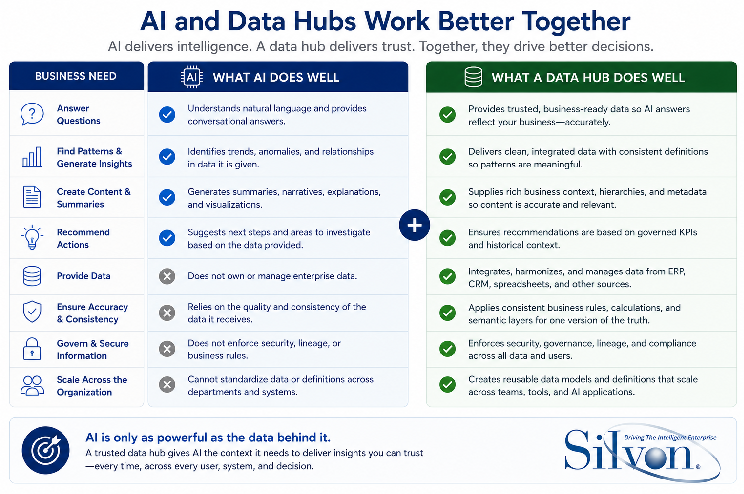
Once trustworthy data is available, generative AI becomes an extraordinarily powerful business assistant. For example, AI can:
- Explain performance – Instead of presenting a dashboard full of numbers, AI can summarize what changed and why it matters.
- Discover patterns – AI can identify relationships that might otherwise require hours of manual analysis.
- Accelerate investigation – Executives can ask follow-up questions naturally instead of requesting additional reports from analysts.
- Improve accessibility – Employees who aren’t experts in SQL or analytics can interact with business information conversationally.
- Summarize large datasets – Rather than reading dozens of reports, leaders can receive concise narratives highlighting the most significant changes.
In many organizations, AI becomes an intelligent interface
sitting on top of existing analytics.
What AI Cannot Do on Its Own
Generative AI is powerful, but it doesn’t automatically know how your business operates.
It doesn’t know:
- which ERP system contains the authoritative revenue figures,
- how Finance defines gross margin,
- whether “customer” refers to the billing account or the ship-to location,
- which inventory balances are available versus committed,
- how returns should affect profitability,
- or which version of a KPI executives have agreed to use.
Without that business context, AI may interpret data differently than your organization expects. That’s one reason identical questions asked against different datasets can produce different answers.
The challenge isn’t that AI lacks intelligence. It’s that enterprise data requires business context.
Why Business Context Matters
Humans think in business terms. We think about customers, products, regions, profitability, inventory turns, fill rate and revenue.
Databases don’t. They store tables, keys, indexes, and cryptic field names.
A semantic layer bridges that gap by translating technical data structures into consistent business concepts. Instead of forcing every dashboard, report, analyst, and AI model to interpret raw database tables independently, the semantic layer defines business terms once and makes those definitions reusable throughout the organization.
This consistency benefits people and AI alike.
The Missing Piece: An AI-Ready Data Hub
This is where many organizations discover they need more than an AI tool.
They need an AI-ready data foundation designed to support enterprise-level analytics.
Before exposing enterprise information to generative AI, organizations should establish a governed environment that integrates data from ERP, CRM, spreadsheets, manufacturing, and cloud systems, standardizes business definitions, harmonizes data across departments, applies consistent KPI calculations, maintains historical context, enforces governance and security, and delivers trusted, business-ready information.
These capabilities reduce ambiguity and provide AI with the context it needs to generate reliable insights.
Silvon’s Stratum™ platform was designed around many of these same principles long before generative AI became mainstream.
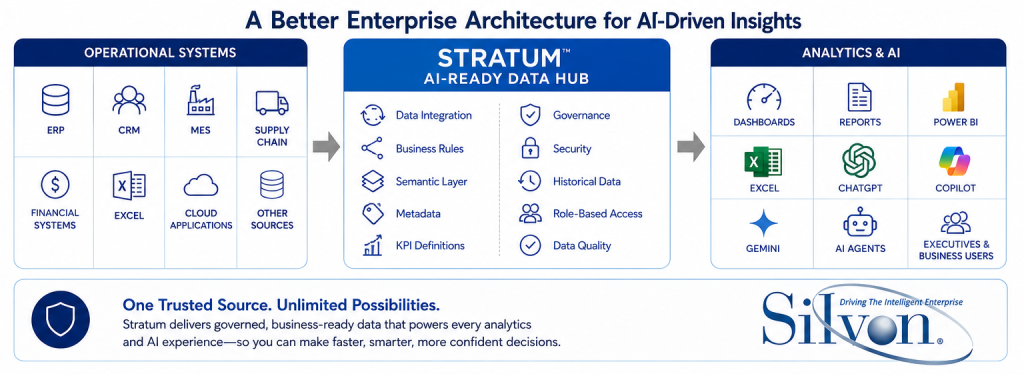
Its AI-ready data hub centralizes and harmonizes information from multiple business systems, applies consistent business rules through a governed semantic layer, and delivers trusted analytics that can be consumed by dashboards, reports, Microsoft Power BI, Excel, and increasingly, enterprise AI tools.
Rather than replacing AI, Stratum strengthens it by ensuring AI begins with trusted business information instead of disconnected raw data.
A Better Enterprise Architecture for AI
Many successful organizations are adopting an architecture that looks something like this:
This approach allows every analytical tool—including AI—to draw from the same trusted source of business truth.
Frequently Asked Questions
Can ChatGPT and other GenAI tools replace business intelligence?
No. Business intelligence creates trusted, governed information. Generative AI makes that information easier to explore, explain, and communicate. The two technologies are complementary.
Can Generative AI tools connect directly to an ERP system?
It can when integrated through appropriate enterprise architectures and connectors, but organizations should carefully manage governance, permissions, and business context using a data hub-based platform for analytics before exposing operational data to AI.
Can AI analyze Power BI reports?
Yes. AI can summarize dashboards, answer questions about visualizations, and help explain trends. However, the quality of those answers still depends on the quality of the underlying data model and business definitions.
Does AI eliminate the need for data governance?
Quite the opposite. As AI adoption grows, governance becomes even more important because inconsistent or poorly defined data can be amplified at machine speed.
The Bottom Line
Generative AI is changing how organizations interact with business information. Instead of searching through dozens of reports, executives can ask questions. Instead of waiting days for analysis, they can receive explanations in seconds.
But the real competitive advantage won’t belong to organizations with access to the latest AI model. It will belong to organizations with the most trusted, governed, and business-ready data.
In the years ahead, AI will become increasingly commoditized. Trustworthy data will not. Organizations that invest today in building an AI-ready data foundation will be better positioned to generate accurate insights, improve decision-making, and confidently leverage AI across finance, operations, manufacturing, supply chain, and executive reporting.
Because in the end, AI doesn’t replace trusted business data. It depends on it.
Ready to See How AI-Ready Your Data Really Is?
Explore more resources in Silvon’s AI & Business Analytics FAQ Center, where you’ll find expert answers to the most common questions about AI, business intelligence, data management, and analytics best practices.