Why AI is Not a Replacement for BI

For the past few years, the business technology world has been captivated by a single question:
Will (or has) AI replaced Business Intelligence?
With the rise of generative AI, conversational analytics, and autonomous agents, it’s easy to understand why some people believe traditional BI platforms, dashboards, and analytics teams are becoming obsolete. After all, if executives can simply ask an AI chatbot a question in plain English and receive an immediate answer, why would they still need reports, dashboards, data models, or analytics platforms?
The answer is surprisingly simple: Because AI doesn’t replace Business Intelligence—it depends on it.
In fact, the organizations achieving the greatest value from AI are not abandoning BI. They’re building AI on top of strong BI foundations.
The Misconception: AI Replaces Analysis
Much of the excitement surrounding generative AI stems from its ability to make data more accessible. That’s undeniably powerful. But accessibility should not be confused with understanding. Generative AI tools cannot reason about business data the way analysts do. They don’t understand corporate definitions, governance policies, financial controls, or operational nuances. They predict statistically likely responses based on patterns in data and language.
As one industry observer noted: AI might talk to the data, but it doesn’t think about the data.
That distinction matters. A chatbot can summarize information and even offer suggestions. But it cannot independently determine whether the underlying data is trustworthy, whether the metrics are correctly defined, or whether the conclusions align with business reality.
Those responsibilities belong to Business Intelligence.
BI Is Much More Than Dashboards
One reason the “AI will replace BI” narrative persists is that many people mistakenly equate BI with dashboards.
Dashboards are simply the visible layer. Underneath every trusted report lies a complex ecosystem of data integration, transformation, governance, semantic definitions, metadata, lineage, security, and business logic.
Business Intelligence encompasses the methodologies, processes, and technologies that transform raw data into meaningful information used to support strategic, operational, and tactical decision-making.
Consider what must exist before an executive can ask an AI assistant: “Why did gross margin decline in the Northeast region last quarter?” Someone—or some platform—must have already established:
- What constitutes gross margin
- Which systems contain the required data
- How those systems are integrated
- Which calculations are approved
- How regional hierarchies are defined
- What data quality standards apply
- Who has permission to access the information
Without that foundation, AI has nothing reliable to analyze. The answer may be conversational, but the infrastructure supporting it is Business Intelligence.
Trust Is the Currency of Decision-Making
Business leaders don’t make decisions because data is available. They make decisions because they trust it. That trust is earned through governance, consistency, transparency, and accountability—areas where BI has spent decades evolving.
Organizations require confidence that today’s revenue number matches yesterday’s revenue number. They need assurance that every department is using the same definitions and calculations. They need visibility into where data originated and how it was transformed.
These are not AI capabilities. These are BI capabilities.
Research increasingly shows that trust remains a critical factor in the adoption of AI-driven analytics. Studies examining augmented analytics environments have found that trust directly influences both BI adoption and decision quality.
In other words, organizations don’t gain value simply because AI generates answers. They gain value when users trust those answers enough to act on them.
AI Still Needs Human-Created Context
One of the most overlooked realities of generative AI is that it lacks institutional context.
An AI model may know what a supply chain is. It may know how financial statements work. But it does not inherently know how your company defines inventory turns, customer profitability, supplier performance, or revenue recognition.
Every meaningful business metric exists because someone designed it. Every KPI exists because someone determined what matters. Every dashboard exists because someone translated business objectives into measurable outcomes.
As recent industry research notes, AI systems often struggle not because they lack intelligence, but because they lack context. Without structured, governed business information, AI outputs become unreliable and prone to hallucinations.
This is why conversational analytics does not eliminate the need for BI. It increases the importance of it. The more natural and accessible AI becomes, the more critical it is that the underlying data foundation remains accurate and governed.
The Real Problem Isn’t AI—It’s Data
Many organizations today are discovering the uncomfortable truth that their AI initiatives aren’t failing because of AI. They’re failing because of data.
Industry experts increasingly argue that enterprises do not have an AI problem—they have a data problem. Poor governance, inconsistent definitions, fragmented systems, and low data quality continue to undermine AI initiatives and limit their ability to scale.
This should sound familiar to anyone who has worked in Business Intelligence. For years, BI teams have focused on solving exactly these challenges:
- Integrating disparate data sources
- Harmonizing business definitions
- Managing master data
- Ensuring quality and consistency
- Creating trusted reporting frameworks
Ironically, the rise of AI has made these disciplines more valuable than ever. The organizations most likely to succeed with AI are often those that have already invested in mature BI and data management practices.
From Dashboards to Conversations
None of this means BI will remain unchanged. It won’t.
The way users interact with analytics is already evolving. AI-generated narratives, automated insights, and intelligent recommendations are transforming how information is consumed. AI-powered BI platforms increasingly help users discover insights, identify anomalies, and ask better questions.
The front-end experience is becoming conversational. But the back-end requirements remain remarkably similar.
- Data still needs governance.
- Metrics still need definitions.
- Business rules still need management.
- Trust still needs validation.
The dashboard may eventually become a chatbot, but the foundation supporting it remains Business Intelligence.
The Future Is Augmented Intelligence
Perhaps the most productive way to view AI is not as a replacement for BI but as an enhancement to it.
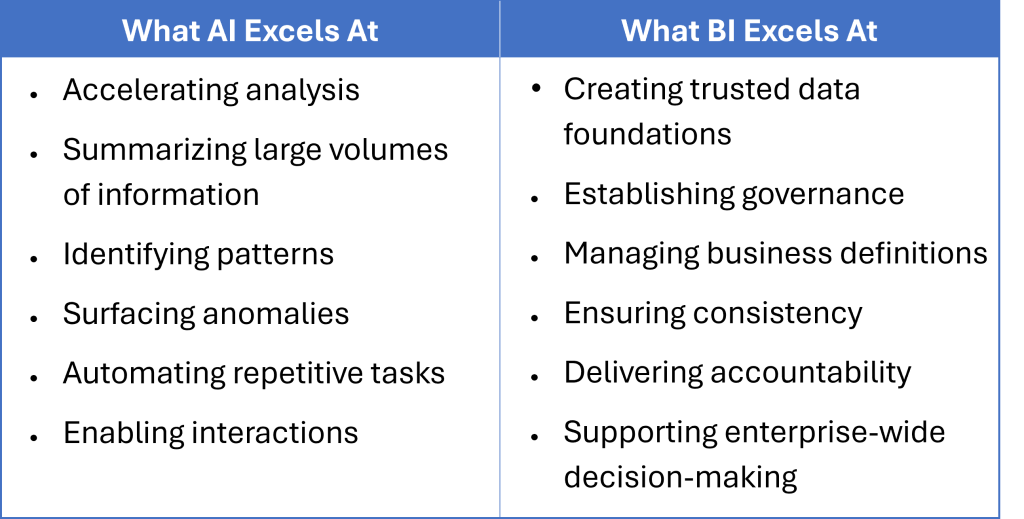
Together, AI and BI create something more powerful than either could provide independently. Many analysts refer to this emerging model as “augmented analytics” or “augmented intelligence” — an environment where AI enhances human decision-making rather than replacing it.
The goal isn’t to remove humans from the process. The goal is to help humans make better decisions faster.
The Bottom Line
When you think about it, every major technology shift creates predictions about what will disappear.
- Cloud computing was supposed to eliminate IT operations.
- Self-service analytics was supposed to eliminate analysts.
- Machine learning was supposed to eliminate data scientists.
None of those predictions fully materialized. Instead, each technology changed how work was performed and elevated the importance of foundational disciplines.
AI is following the same path. Business Intelligence is not disappearing. It is evolving.
The dashboards of today may become conversational experiences tomorrow. Reports may become narratives. Analytics may become proactive rather than reactive. But none of those advancements eliminate the need for trusted data, governed metrics, business context, or analytical rigor.
Real transformation isn’t about replacing systems. It’s about respecting the foundation while enabling the future. AI isn’t here to replace BI—it’s here to amplify it. Because insights don’t live in algorithms. They live in human understanding, supported by trusted data and disciplined analytics.
The future belongs to organizations that recognize this distinction.
It’s not AI instead of BI, but AI powered by BI.