How AI Is Improving the Sales Forecast
 Sales forecasting has always involved a certain amount of educated guesswork. Sales leaders look at last year’s numbers, current orders, customer conversations, promotional plans and what their teams are telling them. Finance adds its perspective. Management makes adjustments. Eventually, everyone agrees on a number—or at least a number they can live with.
For manufacturers and distributors, however, getting that number right is becoming increasingly difficult. A sales forecast may need to account for thousands of combinations of customers, products, channels and locations. Promotions can temporarily alter buying patterns. Pricing changes can affect volume. Retail POS activity may signal changes that haven’t yet appeared in customer orders. New products have little sales history. And a seemingly stable account can begin changing its purchasing behavior long before the effect becomes obvious in revenue.
This is where artificial intelligence is beginning to change sales forecasting.
Rather than simply extending historical trends, AI-based models can examine a much broader collection of sales and customer information, identify relationships within that information, and continually compare expectations with what is actually happening.
The result isn’t a crystal ball. It’s a better-informed sales forecast and potentially a much earlier indication of where revenue opportunities and risks are developing.
 Moving Beyond the Traditional Sales Forecast
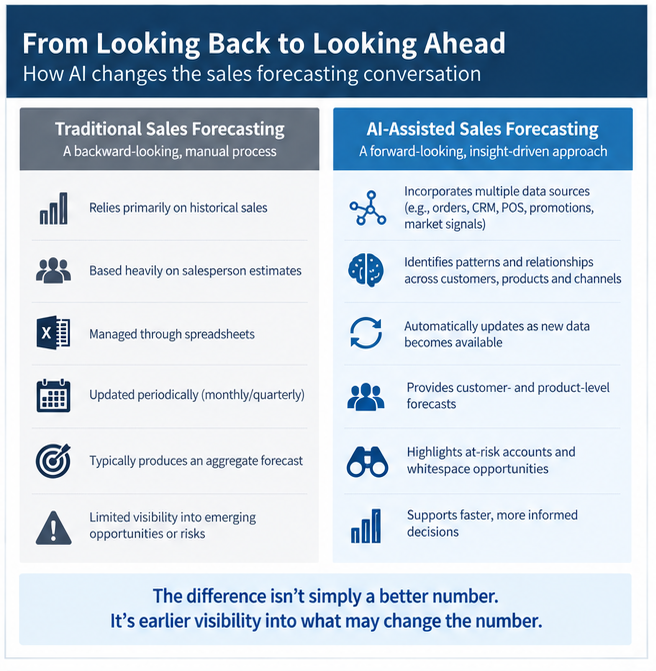
Traditional forecasting often depends heavily on historical sales, spreadsheets and input from individual sales representatives. Each of those sources remains valuable. But each also has limitations.
Historical sales tell you what happened, not necessarily what is about to happen. Spreadsheets become difficult to maintain as products, customers and sales channels multiply. And salesperson forecasts inevitably incorporate individual judgment, along with varying degrees of optimism or conservatism.
For sales leaders, the real value emerges when the forecast moves beyond one company-wide revenue number. The question is no longer simply “How much will we sell next quarter?” It becomes “Which customers, products and opportunities will get us there and where are we most likely to miss?”
That’s where sales forecasting starts becoming much more useful.

Starting With a Better Customer-Level Sales Forecast
Consider a hardware tools manufacturer selling thousands of SKUs through home-improvement chains, industrial distributors, independent dealers and online channels. A traditional forecast might begin with last year’s sales by customer and apply an expected growth rate. An AI-assisted forecast can go deeper, examining purchasing patterns by account, product category, week, geography and channel.
The analysis might discover that an industrial distributor consistently increases purchases of certain tools before construction activity accelerates in its region. A home improvement chain may show a strong relationship between promotional activity and particular product categories. Another customer may be steadily shifting purchases from individual products toward bundled kits.
Those patterns can become part of the customer-level sales forecast. This doesn’t eliminate the account manager’s input. Instead, it gives the account manager an analytical forecast to compare against his or her own expectations. And the differences can be revealing.
Why does the salesperson expect $1.8 million from an account when its current purchasing behavior points closer to $1.5 million? There may be a good reason like a new store rollout, a pending contract or a planned promotion that isn’t visible in historical sales. Or there may not be. Either way, management now knows where to focus the conversation.
In its research on predictive sales forecasting, McKinsey describes a global manufacturer that replaced a largely manual sales forecasting process with a machine-learning model incorporating richer information, including product life-cycle data, historical growth and sales figures, survey results and external market events. The company improved the accuracy of its short-term forecasts and could quickly generate updated sales profiles based on current orders and geographic economic information.
But improving the starting forecast is only part of the opportunity. Once a company has established what it expects each customer to buy, the next question becomes even more valuable: Which of those expectations are beginning to change?
 Seeing Revenue Risk Before It Reaches the Income Statement
Imagine a wholesale meat distributor with a large regional restaurant group that has purchased approximately $3 million annually for several years. On the surface, the account still looks healthy. But underneath the total, something is changing.
Order frequency has declined. Purchases in two important product categories are down. Average days between orders have increased. Several higher-margin specialty items have disappeared from recent orders. And the customer’s purchasing pattern now looks increasingly different from comparable accounts.
No single change necessarily warrants alarm. Taken together, however, they may indicate that the $3 million customer isn’t going to remain a $3 million customer.
AI-based analysis can continually compare customer activity with historical patterns and flag meaningful departures from what would normally be expected. That turns forecasting into an early-warning mechanism.
Instead of discovering the problem after quarterly revenue misses the forecast, the salesperson can investigate while there may still be time to change the outcome. Perhaps the customer has found another supplier. Perhaps menu changes are affecting certain purchases. Or maybe new locations are being supplied through a competitor.
Whatever the explanation, earlier visibility gives the sales organization an opportunity to act rather than simply report the miss later. And the same analysis that exposes downside risk can reveal something equally important: hidden upside.
 Finding the Sales That Aren’t in the Forecast Yet
Consider a manufacturer of vitamins and dietary supplements selling through drug chains, grocery retailers, mass merchants and health-product distributors. One regional customer purchases heavily from the company’s multivitamin and mineral lines but buys relatively little from several other categories.
On its own, that may not seem unusual. But suppose an AI model compares that customer’s purchasing profile with similar retailers and discovers that comparable accounts routinely purchase several additional product categories. It also finds that those categories perform particularly well in markets similar to the customer’s geographic footprint.
Now the forecast has uncovered something traditional extrapolation might miss, and that’s potential revenue that isn’t yet represented in the customer’s historical run rate. The sales team can investigate whether there is a legitimate assortment or distribution opportunity.
This kind of analysis can evaluate product affinities, account size, geography, purchase frequency, category penetration and the buying behavior of comparable customers to identify where additional sales appear most plausible. Rather than telling representatives to “cross-sell more,” management can give them a more useful starting point, highlighting those accounts that appear to have the greatest potential and the products most likely to represent the opportunity.
Once those opportunities enter the sales conversation, however, another complication emerges. Not all future sales will come from normal purchasing patterns. Promotions can temporarily—and sometimes dramatically—change the revenue picture.
 Accounting for Promotions Without Simply Repeating Last Year
For consumer goods businesses, promotions can represent a meaningful portion of the sales forecast. Suppose a snack-food manufacturer is preparing for a four-week promotion with a national grocery chain. The account team expects a substantial increase in sales. But how much should management actually put into the forecast?
Using last year’s promotion as the answer can be misleading. The discount may be different. The promotion may cover more stores. Competitive activity may have changed. The product mix may be different. Timing may have shifted. Consumer behavior may have changed.
Instead, models can compare the planned event with multiple previous promotions, taking into account customer, product, geography, price, discount depth, promotional format, timing and historical lift.
For the sales organization, that means promotional revenue can become a more defensible component of the overall forecast. And it creates a natural next question: Are customers actually selling through the additional product as expected?
 Looking Beyond Shipments to See Where Customer Sales May Be Heading
The question above is especially important for manufacturers that sell through retailers and distributors. Consider a household cleaning products manufacturer. Shipments to a major retail chain appear right on forecast. Based solely on ERP sales, the account looks healthy.
But store-level POS data tells another story. Consumer purchases of several products have begun slowing. Retailer inventory is building. If that pattern continues, future replenishment orders may decline. The company’s ERP may not reveal the problem until the retailer actually reduces its orders. By incorporating downstream POS activity into the sales forecast, the manufacturer may see the change earlier.
The reverse can be equally valuable. Suppose sales of a new cleaning product are accelerating at retail, particularly in two geographic markets. The retailer hasn’t yet increased its normal replenishment pattern, but stronger sell-through suggests additional orders may be coming. POS data therefore becomes more than a measure of consumer activity. It becomes another input into forecasting future sales to the customer.
This illustrates an important advantage of AI-assisted forecasting: it can look beyond what customers have already ordered and consider signals that may help explain what they are likely to order next. But units are only one part of the sales equation. Revenue also depends on the price at which those units are sold.
 Bringing Price and Margin into the Revenue Forecast
Consider a building-products manufacturer selling through distributors and contractor supply houses. Material costs have risen, and management is considering a price increase across several product families. A traditional sales forecast might assume the new price while leaving expected unit volume largely unchanged. Reality may be more complicated.
Some customers may accept the increase with little change in volume. Others may reduce purchases, switch products or negotiate additional discounts. Competitive alternatives may make certain accounts considerably more price-sensitive than others.
Analytical models can examine historical relationships among price, units sold, discounts, customer characteristics, products and competitive conditions to estimate how different pricing scenarios may affect revenue. Management can then move beyond a single price-increase assumption and ask more useful, account-specific questions:
- What happens to expected sales if prices increase 3%?
- Which accounts appear most sensitive to the change?
- Where might lost volume offset the additional revenue?
- Where might pricing opportunities exist that salespeople have not yet recognized?
Once price and promotion effects are incorporated, the sales forecast becomes considerably richer. But there is still one sales situation where historical behavior offers relatively little guidance: launching something new.
 Forecasting Sales When There Is No Sales History
A personal-care products manufacturer preparing to introduce a new skin-care line cannot simply look at last year’s sales for those SKUs. There aren’t any. But that doesn’t mean the company has no useful history.
AI-based models can examine previous introductions and compare characteristics such as product category, price point, package size, customer, channel, geography, season of launch, promotional support and the performance curves of similar products. From that information, the company can establish a reasonable range of expected sales by customer or channel. Salespeople then add what the data cannot know.
One retail account may have committed to prominent shelf placement. Another may be testing the products in only 50 stores. A distributor may already have several large customers expressing interest. The analytical forecast and the salesperson’s market knowledge work together. This illustrates an important theme running through all of these examples: AI doesn’t have to replace sales judgment to improve it.
The emphasis is on using richer customer information and analytics to support better forecasting, pricing and earlier identification of commercial opportunities while preserving the human relationships and judgment at the heart of B2B selling. And that becomes particularly important as forecasting moves from a periodic exercise to a continuous one.
 From Periodic Forecast to Continuous Sales Signal
Once a sales forecast incorporates customer behavior, account opportunities, promotions, POS activity, pricing and new-product expectations, companies don’t necessarily need to wait until the next monthly forecasting cycle to discover that something has changed.
Consider a packaged-food manufacturer halfway through its quarter. Most accounts are tracking close to forecast. But several exceptions emerge:
- A major grocery account is trending 11% below expectations.
- A regional distributor is purchasing a new product family considerably faster than anticipated.
- A planned promotion isn’t producing the expected sales lift.
- Another customer that was forecast as flat has increased both order frequency and average order size.
Rather than asking sales managers to sift through hundreds of accounts and thousands of product/customer combinations, analytical models can identify the exceptions that deserve attention. The sales forecast becomes less of a static report and more of an ongoing sales-management tool.
The question shifts from: “Are we still forecasting $42 million this quarter?” to: “What changed since our last forecast, why did it change, and what should we do about it?”
That is a far more actionable approach to forecasting. But there is a prerequisite for every scenario we’ve discussed. The sales forecasting system has to understand the business information it is analyzing.
 Preparing Your Data for More Intelligent Sales Forecasting
A sales forecasting model can be sophisticated and still produce a poor forecast if the information feeding it is incomplete, inconsistent or misunderstood.
If customer identifiers differ across ERP, CRM and POS systems, the model may not recognize that several records represent the same company. If product hierarchies are inconsistent, it may draw incorrect conclusions about category performance. If promotions cannot be connected to actual sales, their impact becomes difficult to measure. If returns or one-time orders are treated as normal recurring revenue, future projections can be distorted.
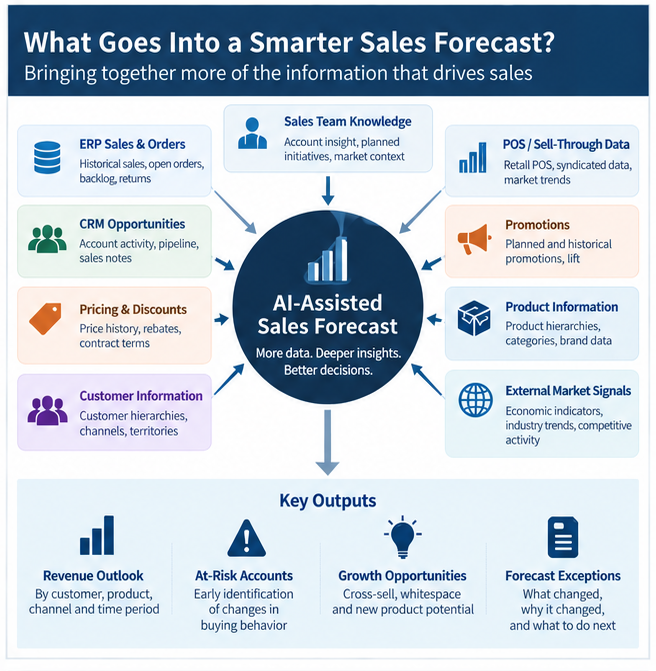
For a manufacturer or distributor, that sales forecasting foundation may need to bring together:
- Historical sales, orders and shipments from ERP
- Open orders and backlog
- Customer and account hierarchies
- Product, category and brand hierarchies
- CRM opportunities and account activity
- Pricing, rebates and discount history
- Promotional programs
- Retailer POS and syndicated information
- Returns and other customer activity
- Sales territories, channels and representative assignments
- Budgets, quotas and previous forecasts
- Relevant external market information
Bringing those sources together, however, is only the first step. The information also needs business meaning. What constitutes net sales? How are returns handled? Which customers belong to which channels? Which individual SKUs roll into a product family or brand? How should acquisitions, discontinued products, unusual bulk orders or customer reorganizations affect historical comparisons?
These aren’t merely technical questions. They determine whether the patterns identified by a sales forecasting model actually represent the business. Before asking AI what sales will look like tomorrow, companies need confidence that it correctly understands how the sales data is delineated.
 The Importance of an Underlying Data Management & Analytics Platform
This is where a business data and analytics platform such as Stratum™ from Silvon can play an important role. For manufacturers and distributors, Stratum provides an environment for bringing sales information together from ERP, CRM, POS, spreadsheets and other sources; organizing that information around consistent customer, product and business definitions; and making it available for reporting, analytics and AI-assisted applications.
That foundation becomes increasingly important as AI applications draw from more information. McKinsey’s 2026 B2B sales research cautions that fragmented data, disconnected processes and weak insights can restrict the value companies obtain from AI. Simply adding AI on top of those problems does not solve them.
This creates an important separation of responsibilities. Stratum can help establish what the company’s business data means and which numbers can be trusted. AI forecasting models can then concentrate on identifying patterns, estimating future sales and highlighting potential opportunities and risks.
That foundation can also make the resulting forecast more useful to the people responsible for delivering it. Rather than receiving a prediction from an isolated model, sales and finance leaders can evaluate the forecast alongside the underlying customers, products, orders, POS activity, pricing, promotions and other business information that influenced it.
That transparency matters. Because sales leaders shouldn’t be expected to accept a forecast simply because an algorithm produced it. They need to understand the business evidence behind it.
 The Goal Isn’t an AI Forecast. It’s a Better Sales Decision.
Ultimately, the opportunity isn’t to replace the traditional sales forecast with an AI-generated number. It’s to make the forecast more useful. Not by taking judgment away from salespeople, but by giving them better evidence on which to base it and more time to act on what that evidence is telling them.
The Silvon Advantage
Since 1987, Silvon has helped more than 2,000 businesses worldwide make better sales and operations decisions by turning complex business data into trusted, actionable information. Today, that same foundation is becoming increasingly important as companies look to AI to improve sales forecasting and other critical business processes.
Silvon’s Stratum™ solution brings together sales, customer, product, inventory, POS and other information from across the business; aligns it around consistent definitions and relationships; and makes that business-ready data available for reporting, analytics and AI-driven applications.
With Stratum, better sales forecasting doesn’t start with AI. It starts with giving AI the right data, the right business context and a trusted foundation from which to work.