Augmented Analytics: Where AI and Business Analytics Deliver Better Decisions Together
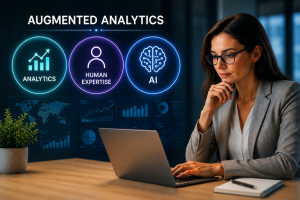 As organizations race to adopt AI, many are discovering that technology alone doesn’t create better business decisions. As a matter of fact, many enterprise AI initiatives are falling short of expectations because while AI can speed up data analysis, executives lack confidence that the insights they receive are accurate, explainable, and aligned with the realities of their business.
This growing realization is changing the conversation. Rather than viewing AI as a replacement for BI tools or people who handle business analysis and reporting tasks, forward-thinking organizations are embracing augmented analytics, a collaborative approach that combines artificial intelligence with trusted enterprise data and human expertise.
The objective isn’t simply to automate analysis. It’s to make high-quality analytics faster, more accessible, and more actionable for everyone who makes business decisions.
Key Components of Augmented Analytics
Unlike many tools that rely on analysts to prepare data, build dashboards, and generate reports, augmented analytics uses AI to automate many of these tasks. Business users can then ask questions in natural language, uncover hidden patterns, identify anomalies, receive automated explanations, and explore data interactively—without waiting for someone else to build the next report.
This democratization of analytics is one of the reasons Gartner has identified augmented analytics as a transformational capability for modern data and analytics platforms. By adding artificial intelligence into the data analysis process, organizations can extend advanced analytical capabilities beyond data scientists and IT specialists to finance, operations, sales, and supply chain leaders who make decisions every day.
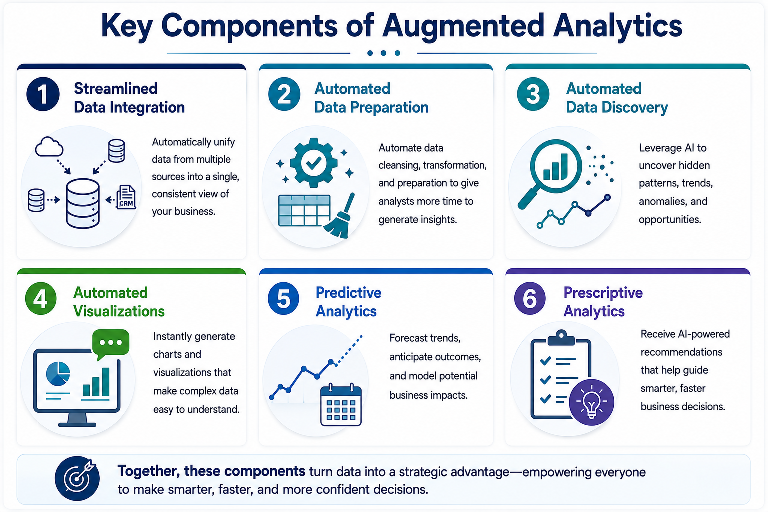
As illustrated above, augmented analytics includes the following capabilities:
- Streamlined data integration
Instead of manually stitching together data from multiple sources, augmented analytics can automate the process by intelligently mapping, merging, and aligning data from different systems to provide a unified view of your operations.
- Automated data preparation
A number of data preparation tasks beyond basic data cleaning can be handled by augmented analytics, too, saving hours of manual work while giving analysts more time to actually analyze the data.
- Automated data discovery
Using statistical techniques, augmented analytics can scan huge datasets and automatically highlight patterns, trends, and anomalies, surfacing insights you may not have thought to look for.
- Automated visualizations
Without having to know how data is structured, users can simply present questions via AI-assisted prompts to automatically generate charts and visuals that help them quickly understand the story behind the numbers.
- Predictive analytics
By analyzing historical data, augmented analytics can forecast trends, identify likely outcomes, and even model how changing one variable could affect another.
- Prescriptive analytics
Augmented analytics doesn’t just tell you what might happen, it suggests what to do next. Whether it’s flagging risks or highlighting opportunities, it helps guide decisions with actionable recommendations.
It’s important to note here that the faster augmented analytics generate insights and recommendations, the more important it becomes that those insights are based on consistent business definitions, governed metrics, and reliable enterprise information. Augmented analytics doesn’t eliminate the need for trusted data. It makes that requirement even more critical.
The Data Readiness Challenge
While most organizations find it easy to implement AI, they often struggle in preparing their data for it because the data lives everywhere.
ERP systems, CRM platforms, spreadsheets, operational databases, cloud applications, supplier portals, POS systems, and countless departmental reports often contain conflicting versions of the same business information.
Even worse, the meaning behind the data is frequently missing. One department’s definition of “gross margin” may differ from another’s. Customer hierarchies vary across systems. Product classifications evolve over time. Financial calendars don’t always align.
An AI tool doesn’t know which version is correct. It simply processes the information it is given. That’s why augmented analytics must begin with trusted, governed, business-ready information.
Business Context Is What Makes AI Intelligent
Business context is what transforms data into intelligence. That means consistent KPI definitions, business hierarchies, master data governance, business terminology, and metadata that explains what every metric actually means. When this business context exists, AI recommendations become dramatically more trustworthy because they’re based on information the business already understands and trusts.
This is where a modern data foundation like Silvon’s Stratum™ plays a critical role. A modern data stack for augmented analytics collects, harmonizes, and governs information from ERP systems, CRM applications, spreadsheets, cloud platforms, and other operational data sources. The information is enriched with the business logic that AI cannot infer on its own. This is done using a semantic layer that provides common business definitions across departments, governed KPIs and calculations, business hierarchies and dimensional structures, and shared business glossary and metadata.
The result is a trusted set of data that supports every analytics initiative while simultaneously providing AI with reliable, business-ready information. Instead of asking AI to interpret inconsistent data, organizations can confidently leverage AI on top of governed information that already reflects how the business operates.
Even more, a modern data foundation supporting augmented analytics also provides a solid line of defense for data governance by incorporating security measures to ensure that users only see the information they are authorized to view when interacting with a GenAI tool or agent. This ensures that the AI assistant is not inadvertently exposing sensitive data that users shouldn’t have access to, reducing compliance risk and maintaining trust.

Augmented Analytics in Action
The ultimate promise of augmented analytics is that with the right tools, clean data, and a little curiosity, anyone on your team can go from asking what happened to deciding what to do next. And no one needs to be a data expert to get value from your data.
It’s not about replacing analysts. It’s about giving every decision-maker the power to explore, dig deeper, and act on data without waiting in line for a dashboard.
Imagine a sales executive prompting an AI assistant with the question “Why has customer profitability declined?” Without a governed data foundation, AI may analyze incomplete transactions, inconsistent cost allocations, or outdated customer classifications. The answer may sound convincing—but still be wrong.
Now imagine the same question powered by augmented analytics. The AI assistant analyzes trusted data from the intelligent data foundation using standardized profitability calculations, governed customer hierarchies, product classifications, supplier information, and historical business context.
It identifies the contributing factors, presents supporting analytics, and allows the executive to validate the recommendations using dashboards, reports, and operational metrics. Instead of flipping between fragmented dashboards, you get a unified, interactive view that connects the dots, reveals trends, patterns and anomalies, and prompts your next question—so you can plan proactively, not just react.
Even more, augmented analytics doesn’t just tell you what might happen, it suggests what to do next. Whether it’s flagging risks or highlighting opportunities, it helps guide decisions with actionable recommendations, making it especially valuable in fast-moving environments where timing is everything.
Human Expertise Is Still the Competitive Advantage
For all the excitement surrounding the use of AI to analyze business data, one truth remains unchanged: the insights needed to drive its success still come from people. They understand the nuances of a customer relationship, the impact of a supplier disruption, the realities of a production schedule, or the strategic priorities that influence every important business decision.
This is where augmented analytics delivers its greatest value.
Rather than asking organizations to choose between human expertise and artificial intelligence, augmented analytics combines the strengths of both. The result is a decision-making process that is both faster and more reliable, ultimately allowing decision-makers to focus on evaluating options, weighing tradeoffs, and taking action with confidence.
The Future of AI-Driven Business Analytics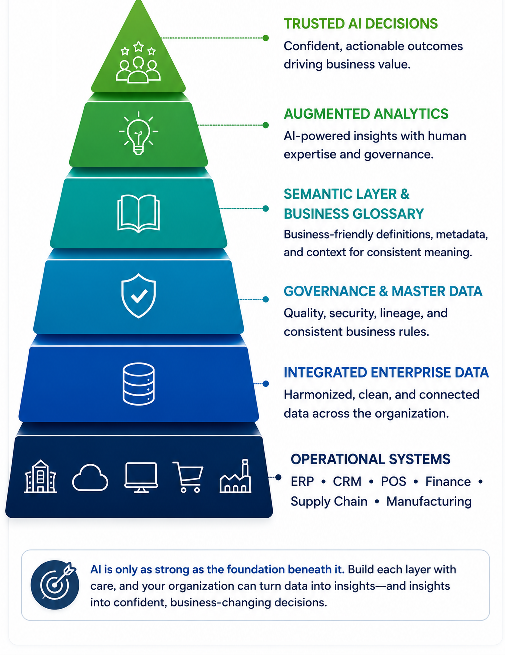
Organizations that realize the greatest return on AI won’t necessarily be those with the newest models or the largest technology investments. They’ll be the ones that establish a trusted data foundation, apply consistent business context, and empower their people with tools that make intelligence more accessible and actionable.
Ultimately, the future of enterprise analytics isn’t about replacing human intelligence—it’s about augmenting it. When AI is built on governed, business-ready data and paired with the experience of the people who understand the business best, organizations gain something far more valuable than automated answers: they gain the confidence to make better decisions.