Manufacturing Analytics: 4 Things Successful Businesses Do
 Today’s most important manufacturing analytics center on transforming production, maintenance, quality, supply chain, workforce, and planning data into connected systems that improve operational decision-making.
Manufacturing analytics is no longer limited to dashboards or isolated pilot projects. It is evolving into an operational decision system that helps manufacturers determine what to produce, where bottlenecks are emerging, which materials may become constrained, and which assets require attention.
This article explores the manufacturing analytics trends gaining momentum today and outlines how manufacturers can turn those trends into measurable business value.
Why Manufacturing Analytics Is Evolving
For years, manufacturing analytics focused heavily on the simple reporting of data from a single production system. Organizations relied on OEE dashboards, downtime reports, quality scorecards, and inventory snapshots to monitor operations. While those tools still play an important role, they are no longer enough on their own.
Manufacturers are now expected to improve throughput, profitability, resilience, and customer service simultaneously. Achieving those goals requires analytics capable of connecting factory-floor data with broader enterprise context, including orders, suppliers, maintenance schedules, inventory levels, financial impact, production constraints, and customer commitments.
Companies that are driving the most value from analytics are the ones that do these four things:
- Connect their IT and operational data;
- Upgrade their analytics platforms beyond traditional reports and dashboards;
- Employ predictive analytics to better forecast and respond to events; and,
- Incorporate the use of AI to support workflows, alerts, handovers, root-cause analysis and actions for expedited decisions.
1. IT and OT Data Integration Becomes the Foundation of Smart Manufacturing
What many manufacturers have come to realize over recent years is that smart manufacturing cannot scale without connected IT and OT environments.
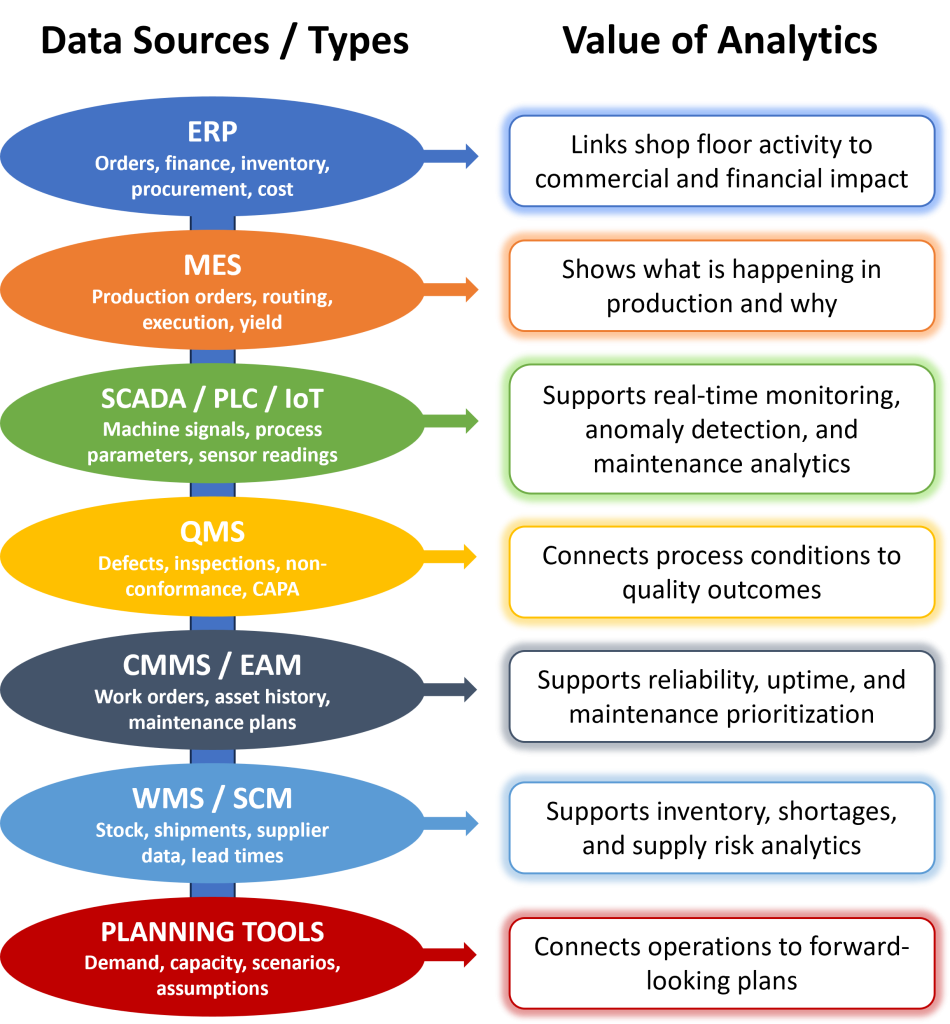
Operational technology data generated by machines, sensors, SCADA systems, and MES applications often exist separately from enterprise systems such as ERP, finance, planning, quality, and supply chain platforms. That separation limits the value analytics can deliver.
A machine sensor may reveal a production stoppage, but understanding the full business impact requires additional context. Which customer order was affected? What materials were constrained? Which batch was involved? What financial impact will result?
This is why IT/OT integration has become one of the most critical manufacturing analytics priorities. The goal is not merely connecting machines. It is creating a trusted data foundation that links production lines, machines, work orders, suppliers, downtime events, maintenance activity, inventory, energy usage, defects, and costs into a unified operational view.
Data Sources That Manufacturers Need to Connect
2. Manufacturing Analytics Platforms Move Beyond Dashboards
Manufacturing analytics platforms are also evolving beyond traditional reporting tools like dashboards. While dashboards certainly remain valuable (and imperative) for monitoring throughput, downtime, OEE, scrap, defects, service levels, energy consumption and inventory, they rarely drive operational improvement. The next level of manufacturing analytics supports alerts, root-cause analysis, workflow automation, scenario modeling, and AI-assisted recommendations.
To accomplish this, modern analytics platforms must be designed with an architecture that includes:
- Multiple Data Sources – ERP, MES, IoT, SCADA, QMS, planning, finance, supplier, and maintenance systems.
- Integration Layer – APIs, streaming pipelines, event processing, and batch ingestion.
- Data Foundation – Lakehouse/warehouse/hub, semantic layer, manufacturing data model, KPI definitions, and master data management.
- Analytics Layer – BI dashboards, predictive analytics, and self-service reporting.
- Workflow Layer – Alerts, approvals, planning workflows, maintenance workflows, and operational decision support.
- Governance Layer – Data quality, lineage, access control, monitoring, and ownership.
3. Predictive Supply Chain Analytics Replaces Reactive Reporting
Another trend in manufacturing analytics is the movement from basic supply chain visibility to predictive supply chain intelligence. Many manufacturers already track inventory levels, late shipments, supplier performance, and open purchase orders. But by the time shortages or delays appear in a report, operational disruptions may already be unavoidable.
Manufacturers increasingly need analytics that can answer forward-looking operational questions, such as:
- Which materials are likely to become constrained before the next production cycle?
- Which customers, plants, or product lines will be impacted if supplier lead times change?
- Where do demand fluctuations create capacity or inventory risks?
- Which production orders are vulnerable because of staffing, machine, supply, or quality constraints?
- What financial impact will each scenario create?
Organizations gaining the greatest advantage are those connecting demand, inventory, supply, planning, capacity, and supplier-risk data into predictive decision models using a modern manufacturing analytics platform.
4. AI Becomes Part of Daily Manufacturing Operations
Taking predictive manufacturing analytics further is AI, particularly the transition from AI experimentation to AI-driven operational workflows. Many manufacturers have already explored AI through pilot projects involving predictive maintenance, demand forecasting, defect detection, AI “chat-generated” reporting, and automated documentation. The next challenge is determining which AI applications are reliable enough to support real operational decisions.
Deloitte’s 2026 Manufacturing Industry Outlook identifies agentic AI as a key component of next-generation manufacturing operations. This form of AI can facilitate automated shift handoff reporting, supplier identification, equipment repair support, work instruction generation, and institutional knowledge capture.
For analytics teams, this changes the role AI plays within the organization. Rather than simply creating dashboards or reports for employees to interpret, manufacturers can now design AI-supported workflows to monitor operational signals, identify anomalies, summarize changes, surface exceptions, and recommend next steps for operators, planners, maintenance teams, and plant managers.
How Manufacturers Should Prepare
A practical manufacturing analytics roadmap should begin by identifying the decisions that analytics can improve most effectively. Production planning, maintenance prioritization, quality improvement, and supply chain optimization are often strong starting points.
Source systems and data owners then need to be identified. High-value use cases need to be prioritized. KPI definitions need to be standardized. And trusted data pipelines capable of supporting repeatable analytics need to be put into place.
From there, dashboards, predictive analytics, forecasting, anomaly detection, and eventually AI-assisted workflows where operational processes are clearly defined can be introduced.
Equally important is governance. Ownership, quality standards, monitoring, security, and access controls must be established to ensure that the analytics system remains trusted and scalable.
Finally, it’s important for manufacturers to continuously measure adoption and business impact. The true value of manufacturing analytics is realized when it improves operational decisions, reduces manual effort, shortens response times, protects revenue, and improves business performance.
This is where the right manufacturing analytics platform partner can make a significant difference.
Finding the Right Manufacturing Technology Partner
When evaluating solutions, don’t just focus on the features — look closely at who’s behind the platform. The right manufacturing analytics solution provider brings more than just technology to the table. They bring industry knowledge, proven implementation experience, and a commitment to helping manufacturing businesses like yours succeed.
Silvon Software is a long-time provider of analytic applications for mid-market manufacturers across numerous industries. To learn more about our Stratum business analytics and data management platform, visit our website at www.silvon.com